Behaviour & Training
Using KONGs To Build Calmness & Engagement
A properly introduced KONG is not simply a chew toy — it is a training tool used to encourage calmness, patience, quiet behaviour, crate confidence and relaxation.
Behaviour & Training
Registered Charity #1188407
Behaviour & Training
A properly introduced KONG is not simply a chew toy — it is a training tool used to encourage calmness, patience, quiet behaviour, crate confidence and relaxation.
Reader
USING KONG TO BUILD CALMNESS & ENGAGEMENT
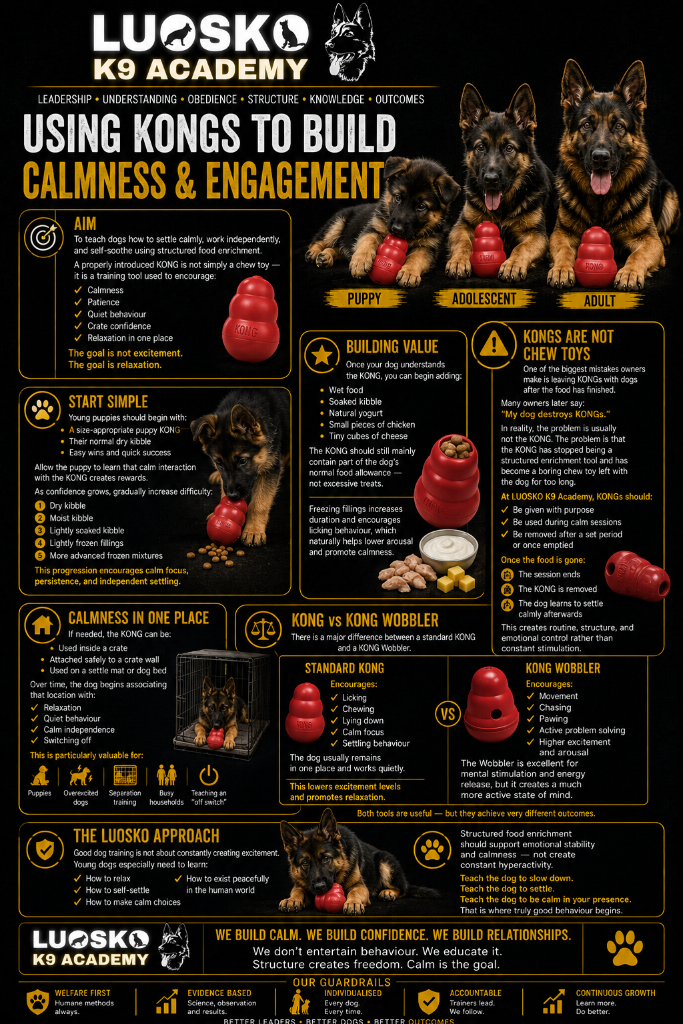
AIM: To teach dogs how to settle calmly, work independently, and self-soothe using structured food enrichment. A properly introduced KONG is not simply a chew toy — it is a training tool used to encourage: Calmness, Patience, Quiet behaviour, Crate confidence, Relaxation in one place. The goal is not excitement. The goal is relaxation.
START SIMPLE Young puppies should begin with: A size-appropriate puppy KONG, their normal dry kibble, easy wins and quick success. Allow the puppy to learn that calm interaction with the KONG creates rewards. As confidence grows, gradually increase difficulty: 1. Dry kibble, 2. Moist kibble, 3. Lightly soaked kibble, 4. Lightly frozen fillings, 5. More advanced frozen mixtures.
BUILDING VALUE Once your dog understands the KONG, you can begin adding: Wet food, Soaked kibble, Natural yogurt, Small pieces of chicken, Tiny cubes of cheese. The KONG should still mainly contain part of the dog's normal food allowance — not excessive treats. Freezing fillings increases duration and encourages licking behaviour, which naturally helps lower arousal and promote calmness.
KONGS ARE NOT CHEW TOYS One of the biggest mistakes owners make is leaving KONGs with dogs after the food has finished. Many owners later say: 'My dog destroys KONGs.' In reality, the problem is usually not the KONG. The problem is that the KONG has stopped being a structured enrichment tool and has become a boring chew toy left with the dog for too long. At LUOSKO K9 Academy, KONGs should: Be given with purpose, Be used during calm sessions, Be removed after a set period or once emptied. Once the food is gone: The session ends, The KONG is removed, The dog learns to settle calmly afterwards.
CALMNESS IN ONE PLACE If needed, the KONG can be: Used inside a crate, Attached safely to a crate wall, Used on a settle mat or dog bed. Over time, the dog begins associating that location with: Relaxation, Quiet behaviour, Calm independence, Switching off.
KONG vs KONG WOBBLER STANDARD KONG encourages: Licking, Chewing, Lying down, Calm focus, Settling behaviour. The dog usually remains in one place and works quietly. This lowers excitement levels and promotes relaxation. KONG WOBBLER encourages: Movement, Chasing, Pawing, Active problem solving, Higher excitement and arousal. The Wobbler is excellent for mental stimulation and energy release, but it creates a much more active state of mind. Both tools are useful — but they achieve very different outcomes.
THE LUOSKO APPROACH Good dog training is not about constantly creating excitement. Young dogs especially need to learn: How to relax, How to self-settle, How to make calm choices, How to exist peacefully in the human world. Structured food enrichment should support emotional stability and calmness — not create constant hyperactivity. Teach the dog to slow down. Teach the dog to settle. Teach the dog to be calm in your presence. That is where truly good behaviour begins.
WE BUILD CALM. WE BUILD CONFIDENCE. WE BUILD RELATIONSHIPS. We don't entertain behaviour. We educate it. Structure creates freedom. Calm is the goal.
Behaviour & Training
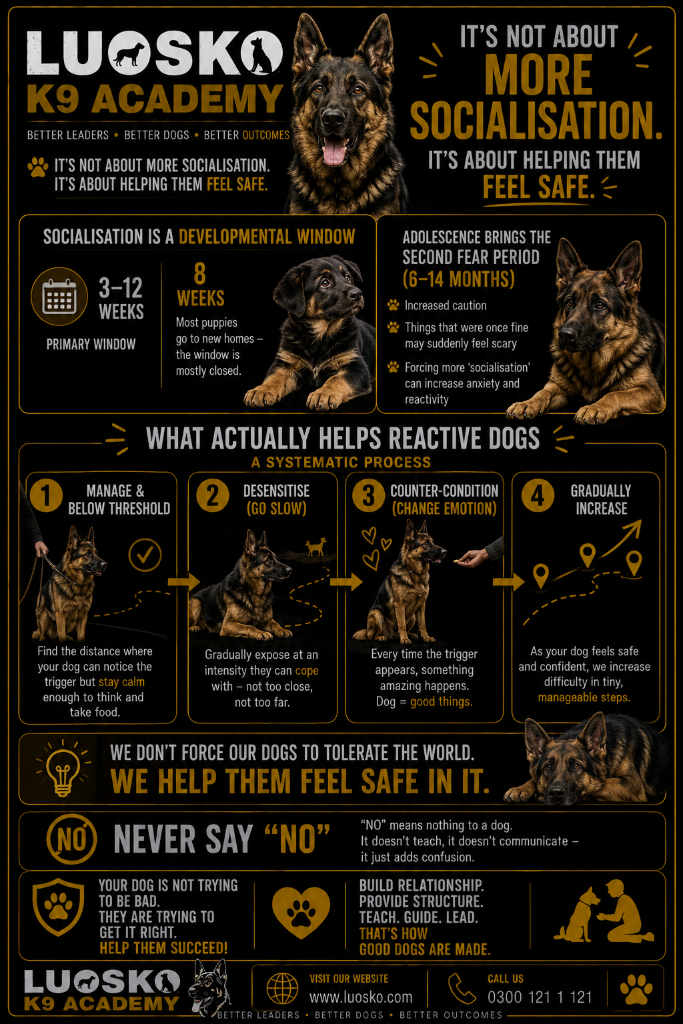
It's not about more socialisation — it's about helping your dog feel safe. A systematic process for reactive dogs.
5 minute read
View Guide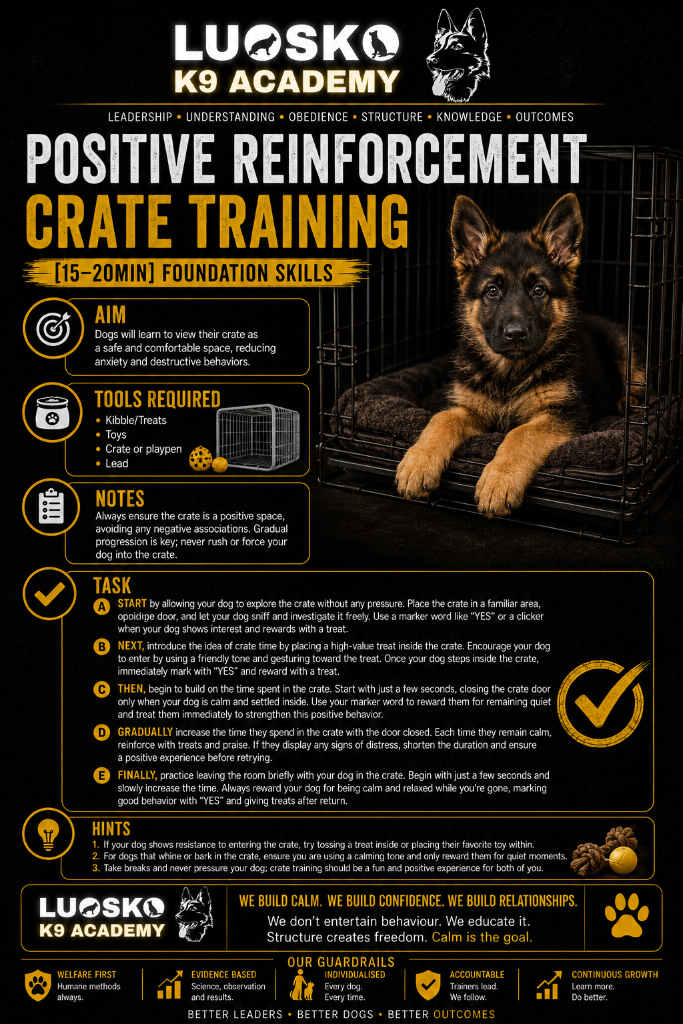
Behaviour & Training
A 15–20 minute foundation skills guide to teaching dogs to view their crate as a safe and comfortable space using positive reinforcement.
5 minute read
View Guide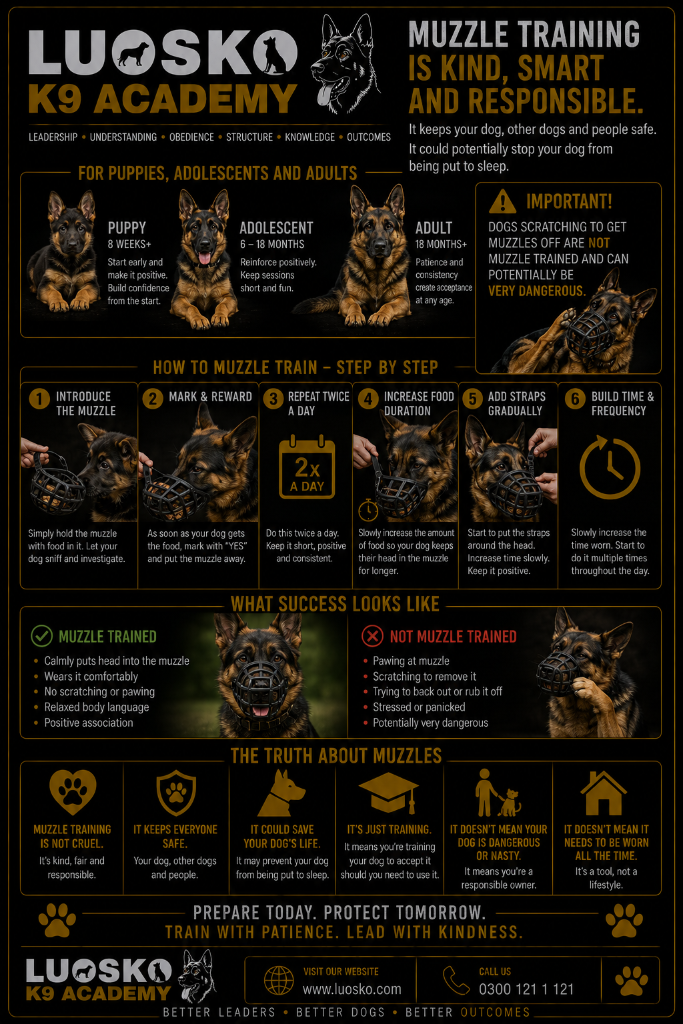
Behaviour & Training
Muzzle training is kind, smart and responsible. It keeps your dog, other dogs and people safe. It could potentially save your dog's life.
6 minute read
View GuideLUOSKO Guide
Behaviour & Training
A properly introduced KONG is not simply a chew toy — it is a training tool used to encourage calmness, patience, quiet behaviour, crate confidence and relaxation.
USING KONG TO BUILD CALMNESS & ENGAGEMENT
AIM: To teach dogs how to settle calmly, work independently, and self-soothe using structured food enrichment. A properly introduced KONG is not simply a chew toy — it is a training tool used to encourage: Calmness, Patience, Quiet behaviour, Crate confidence, Relaxation in one place. The goal is not excitement. The goal is relaxation.
START SIMPLE Young puppies should begin with: A size-appropriate puppy KONG, their normal dry kibble, easy wins and quick success. Allow the puppy to learn that calm interaction with the KONG creates rewards. As confidence grows, gradually increase difficulty: 1. Dry kibble, 2. Moist kibble, 3. Lightly soaked kibble, 4. Lightly frozen fillings, 5. More advanced frozen mixtures.
BUILDING VALUE Once your dog understands the KONG, you can begin adding: Wet food, Soaked kibble, Natural yogurt, Small pieces of chicken, Tiny cubes of cheese. The KONG should still mainly contain part of the dog's normal food allowance — not excessive treats. Freezing fillings increases duration and encourages licking behaviour, which naturally helps lower arousal and promote calmness.
KONGS ARE NOT CHEW TOYS One of the biggest mistakes owners make is leaving KONGs with dogs after the food has finished. Many owners later say: 'My dog destroys KONGs.' In reality, the problem is usually not the KONG. The problem is that the KONG has stopped being a structured enrichment tool and has become a boring chew toy left with the dog for too long. At LUOSKO K9 Academy, KONGs should: Be given with purpose, Be used during calm sessions, Be removed after a set period or once emptied. Once the food is gone: The session ends, The KONG is removed, The dog learns to settle calmly afterwards.
CALMNESS IN ONE PLACE If needed, the KONG can be: Used inside a crate, Attached safely to a crate wall, Used on a settle mat or dog bed. Over time, the dog begins associating that location with: Relaxation, Quiet behaviour, Calm independence, Switching off.
KONG vs KONG WOBBLER STANDARD KONG encourages: Licking, Chewing, Lying down, Calm focus, Settling behaviour. The dog usually remains in one place and works quietly. This lowers excitement levels and promotes relaxation. KONG WOBBLER encourages: Movement, Chasing, Pawing, Active problem solving, Higher excitement and arousal. The Wobbler is excellent for mental stimulation and energy release, but it creates a much more active state of mind. Both tools are useful — but they achieve very different outcomes.
THE LUOSKO APPROACH Good dog training is not about constantly creating excitement. Young dogs especially need to learn: How to relax, How to self-settle, How to make calm choices, How to exist peacefully in the human world. Structured food enrichment should support emotional stability and calmness — not create constant hyperactivity. Teach the dog to slow down. Teach the dog to settle. Teach the dog to be calm in your presence. That is where truly good behaviour begins.
WE BUILD CALM. WE BUILD CONFIDENCE. WE BUILD RELATIONSHIPS. We don't entertain behaviour. We educate it. Structure creates freedom. Calm is the goal.
We use strictly necessary storage to run this website. We only use analytics and donation tools if you allow us to. You can accept, reject, or choose — rejecting is as easy as accepting. Read the cookie information.